
How to Answer 'Tell Me About Yourself' With No Experience

Quick Answer
With no experience, answer "tell me about yourself" in 60 to 90 seconds using a present-past-future structure: who you are now, proof from projects or part-time work, and why this exact job is next. Never apologize for being new - frame your lack of experience as momentum.
Why This Question Terrifies Beginners (and Why It Shouldn't)
Every interview seems to open the same way, and when you have zero job history, the words land like a trap. The interviewer knows you are new. They read your resume before they walked in. What they actually want is not a list of employers - it is a quick read on who you are, how you think, and whether you can talk about yourself like an adult with direction. Most beginners blow it by either apologizing for being new or reciting their birth certificate. Neither gives the hiring manager anything to work with. Here is the good news: because the bar is simply "can this person talk about themselves with purpose," a well-built 60-second answer from a beginner beats a rambling one from someone with two jobs. The question is an invitation, not an interrogation.
The Present-Past-Future Structure, Rebuilt for Zero Experience
The classic advice says to answer in three beats: where you are now, where you have been, where you are going. For someone with no experience, the middle beat needs a swap. Instead of "where I have worked," use "what I have been building." Present: who you are right now - your field of study, the skills you have been learning, the role you want. Past: the proof that you are serious - coursework, personal projects, volunteering, part-time work, anything that shows effort in this direction. Future: why THIS job, right now, is the logical next step. That structure gives your answer a shape interviewers recognize, and it quietly answers their real question - "is this person worth training?" - before they even ask it.
Stop Apologizing for Being New
The single fastest way to sink your answer is to open with an apology. "I know I don't have any experience, but..." makes the room focus on exactly the thing you are weakest at, and it frames everything after it as a plea instead of a pitch. Nobody hired you to hear that you know you are behind. Drop the word "just" too - "I'm just a student" shrinks you down to a size no one remembers. You can say what is true without making it sound like a confession. "I graduated last spring with a degree in marketing, and I've spent the last year running the social accounts for two campus organizations" says the same facts, except now the facts are working for you. Confidence here is not pretending you have experience. It is refusing to treat its lack as a shameful secret.
Mine Your Real Life for Proof
Beginners almost always have more proof than they think; they just don't file it under "experience." Think of it as a resume archaeology dig. Coursework counts, especially final projects, capstones, and any class where you produced something a stranger could look at. Volunteer shifts count - showing up reliably for eight weeks at a food bank says something concrete about your work ethic. Part-time retail or food service counts even for an office job, because it proves you can handle customers, schedules, and showing up on time. Personal projects count: the website you built, the video series you edited, the language you learned. The projects I was embarrassed to mention - a janky personal blog, a campus newsletter - were the parts interviewers actually leaned into. Proof is anything that lets a stranger conclude: this person finishes things.
Read the Job Description Like a Map
Generic answers die fast because the interviewer has heard them forty times this week. The fix is to tailor every answer to the actual posting. Print the job description, highlight every skill, duty, and quality it names, then go back through your proof pile and match pieces to those highlights. If the posting says "strong written communication" and you ran a campus newsletter, that example goes in your answer - front and center. If it says "data-driven" and you did a statistics project on campus survey data, that is your proof beat. This is not trickery; it is respect. It shows you did the homework of understanding what they need instead of delivering a one-size-fits-all monologue. One more thing the description tells you: the tone. A startup posting sounds different from a school district posting, and your answer's energy should nod at that world.
A Word-for-Word 60-Second Answer You Can Steal
Here is a real answer for a junior marketing applicant - swap in your own details. "I'm a recent marketing graduate, and over the last year I've been getting hands-on with the things I couldn't get from classes alone - I ran social media for our campus entrepreneurship club, growing it from 300 to just under 900 followers, and I built a portfolio site where I write short breakdowns of ad campaigns I admire. Before that I worked two years in campus dining, which taught me how to handle busy shifts and unhappy people without falling apart. What draws me to this role is the focus on content that actually converts - that's the part of marketing I keep coming back to, and I want to learn it on a real team." No job history. Three pieces of proof. Read it out loud until it sounds like you talking.
Body Language and Pacing Matter More Than You Think
The words get you in the door, but the delivery decides whether anyone believes them. Sit upright, plant your feet, and keep your hands still - fidgeting telegraphs the nervousness you are trying to mask. Eye contact matters most at the start and the end of your answer; that is when the interviewer is forming their impression. Pace yourself deliberately, because beginners almost always speed up when they get nervous, and a fast talker sounds like someone trying to get the answer over with. Pause between your three beats. A half-second of silence reads as confidence, not forgetting. If you go blank mid-answer, have a recovery line ready: "Let me give you the short version of that" buys you three seconds and lets you restart cleanly. Nobody remembers the pause. Everybody remembers the recovery.
What NOT to Say
Some sentences should never leave your mouth in this answer. Don't recite your life story from high school onward - the interviewer asked about YOU, not your timeline. Don't overshare personal details; nobody needs to know about your family situation or your salary hopes in the first minute. Don't criticize your school, your old managers, or your generation's job market - negativity in an opener stains everything after it. Don't say "I'm a perfectionist" when they probe weaknesses later; it is the most worn-out line in interviews and it reads as dishonest. And do not wing the whole thing with "I didn't really prepare" as a badge - honesty about being nervous is fine, but announcing you didn't prepare tells them the job doesn't matter much to you. When in doubt, shorter beats longer. A tight 45 seconds beats a wandering two minutes every time.
Use Their Follow-Ups as a Second Chance
If your opening answer lands, the next question is usually a variation on the same theme - "Why should we hire you?" or "What makes you a good fit?" Think of these as the same answer wearing different clothes. You get to reuse your proof pieces with a new frame. "Why should we hire you?" wants the answer: because I will be productive faster than you expect. Point at the learning speed your projects show, then at your work ethic from the part-time or volunteer history, then land on genuine enthusiasm for the specific work. It is a generous question: the interviewer is handing you a second chance to say what you missed. Take it. And if you get a curveball you cannot answer, say so plainly - "I don't have that yet, but here's what I'd do to learn it" - because how you handle not knowing is what they will remember.
Practice Until It Sounds Unpracticed
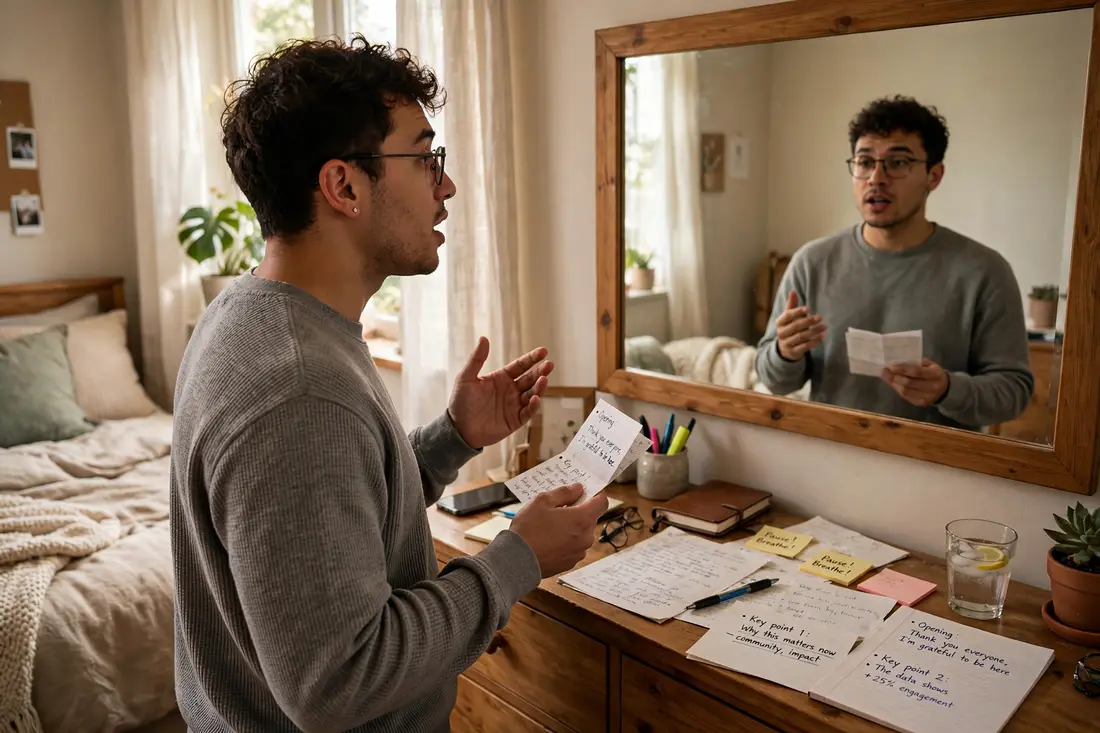
An answer this short deserves real rehearsal, and the rehearsal has a specific goal: you should sound prepared but not memorized. Write your answer down, then rewrite it as bullet points, because reading from a script produces a flat, robotic delivery that interviewers spot instantly. Practice standing, sitting, and on a video call, since posture changes your voice. Record yourself once on your phone and watch it - painful, I know, but five minutes of video shows you every habit your friends would be too polite to mention. Time it. If it runs past 90 seconds, cut the weakest example. Do a mock run with a friend or family member if you can, but practice alone beats no practice at all. The person who sounds natural in the interview rehearsed enough to forget they were rehearsing.
✅ Guide4U Checklist
- Drop apologies and the word just entirely
- Build proof from projects, courses, volunteering, part-time work
- Match your best proof to the job description
- Write your answer down, then rehearse to 60-90 seconds
- Open strong and close with why this job
- Recover with one line if you go blank
Key Takeaways
- The structure is present-past-future, with proof replacing job history in the middle beat.
- Tailoring your proof to the job description is what makes a generic answer memorable.
- Sixty to ninety practiced seconds beat any improvised life story.
Frequently Asked Questions
How long should my answer be with no experience?
Aim for 45 to 90 seconds - roughly 150 to 200 spoken words. That is long enough to give three real pieces of information and short enough to hold attention. Anything past two minutes starts to ramble, and with no job history to draw on, rambling reads as padding. Time yourself during practice and cut until you are comfortably inside the window.
What if I have literally no projects, volunteering, or part-time work to mention?
Then lead with what you ARE doing right now: the skills you are learning, the courses you are taking, and the exact reasons you want this role. Say what you will do in the first month to get up to speed. Honest momentum beats fake experience - and never invent jobs or projects, because interviewers check, and getting caught fabricating ends the process instantly.
Should I mention my degree first or my skills first?
Lead with the thing most relevant to the job. If the posting is skill-heavy, open with what you can do and mention the degree as the source of those skills. If it is a credential-heavy field like teaching or accounting, the degree goes first. The rule is simple: put the strongest, most job-relevant fact in the first fifteen seconds, because that is when attention is highest.
Is it okay to admit I'm nervous?
A brief, honest line like "this is my first real interview, so bear with me" is fine and can even warm the room - but say it once, then move on. Do not repeat it, and do not let it become the theme of the answer. Nervousness is normal and expected; what interviewers judge is whether you can function through it, so show them you can by delivering your prepared answer anyway.