
Best Office Chair for Short or Petite People Under $300: How to Find One That Fits
Quick Answer
The best office chair for a shorter person under $300 has a minimum seat height around 16 to 17.5 inches, a seat depth of about 16 to 17 inches or a slider, and lumbar support that moves up and down to land on your real lower back. Height-adjustable armrests and a return policy that allows a full workday test matter as much as the frame. Measure yourself before ordering, and add a footrest if your feet do not quite reach flat.
Most Office Chairs Are Built for Someone Taller Than You
Walk into any office supply aisle and the chairs are all the same: built for a person around 5'10", tested on someone around 5'10", photographed with a model around 5'10". If you are 5'2" on a tall day, sitting in one feels like being a kid in a grown-up's seat. Your feet dangle, the lumbar bump lands mid-back, and the armrests sit so high your shoulders hike up all day. The good news: you do not need a $900 specialty chair. A chair under $300 can fit a shorter frame well if you know which adjustments matter and which marketing claims to ignore. This guide covers the five fit factors, how to measure yourself at home in ten minutes, and the honest trade-offs at this price.
What "Petite" Means When You Are Chair Shopping
Forget clothing sizes. In chair terms, "petite" usually means someone between roughly 5'0" and 5'4", whose lower-back curve sits lower than standard lumbar supports assume. Your inseam matters more than your height, though. Two people at 5'3" can have very different leg lengths, and a 27-inch inseam needs a lower seat than a 31-inch inseam at the same height. Torso length matters too: a short back means the lumbar bump on a standard chair pokes you between the shoulder blades. When you read a listing, skip the "universal fit" language and look for three numbers: minimum seat height, seat depth, and whether the lumbar support moves up and down. Those tell you more than any photo of a smiling model.
Fit Factor One: Seat Height You Can Actually Use
Sit back with your spine against the backrest: your feet should rest flat on the floor and your thighs should sit roughly level. If the seat's lowest setting leaves your feet dangling or forces you to perch on the front edge, the chair is too tall for you, full stop. Dangling legs cut off circulation behind the knees and nudge you into a forward head-slump that turns into a neck ache by midday. Look for a minimum seat height around 16 to 17.5 inches. Many standard chairs bottom out at 18 or 19 inches, which sounds like a tiny gap until you are the one living with it every workday.
Fit Factor Two: Seat Depth and the Three-Finger Rule
Seat depth, from the front edge to the backrest, decides whether you can sit fully back without the seat pressing into the backs of your thighs. The classic check: with your lower back touching the backrest, slide two or three fingers between the front edge and the back of your knee. Fewer than two fingers and the seat is too deep, which either pushes you into a slouch or presses on your knees all day. Many chairs still ship with 18- to 19-inch seats, which swallow a shorter leg. You want a shallower seat, around 16 to 17 inches of usable depth, or a seat slider that moves the pan forward and back. Sliders are rare under $300, but shallower seats just take a little digging to find.
Fit Factor Three: Lumbar Support That Hits Your Curve
Your lower back has a natural inward curve, and a chair's lumbar support is meant to fill it so your spine keeps its gentle S-shape. On most chairs the lumbar bulge is positioned for a taller torso, so at 5'1" it lands high, poking into your mid-back and pushing your ribcage forward. That feels rotten within an hour. Look for lumbar support that adjusts vertically, not just in firmness. Some chairs move a cushion up and down on a track; others let the whole backrest height slide. Either works. A fixed lumbar bump at a fixed height is a gamble for a petite frame, so treat it as a red flag.
Fit Factor Four: Armrests, the Quiet Dealbreaker
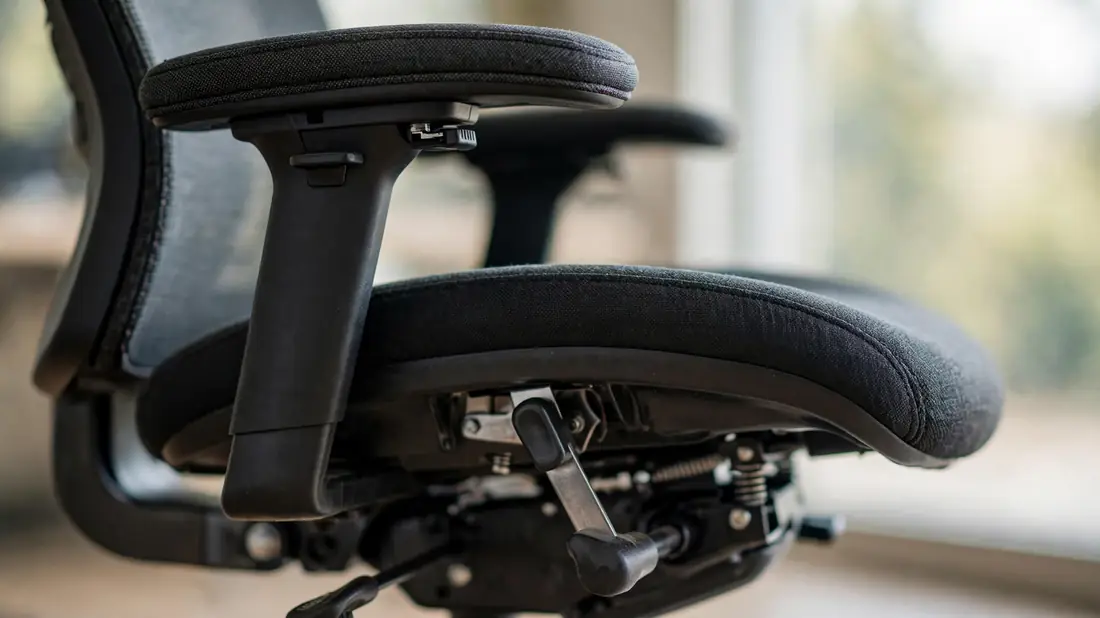
Armrests sound minor until you live with the wrong ones. Fixed armrests on budget chairs often sit 8 to 10 inches above the seat, fine for someone tall, but for a shorter person your shoulders shrug up all day to reach them and the muscles along your neck pay for it. High fixed armrests can also block you from pushing the chair under your desk. Look for height-adjustable armrests at minimum, ideally ones that also slide inward so they sit close to your body instead of wide at your hips. For a fixed-arm chair, measure: anything above about 7 inches from seat to armrest top is likely trouble for a petite sitter.
Fit Factor Five: Foot Support and the Footrest Trick
If the lowest seat you can find still leaves your feet just short of the floor, do not drop an otherwise good chair. A footrest is the honest fix and a genuine ergonomic accessory, not a consolation prize. Supported feet take pressure off the backs of your thighs and keep you from sliding forward as the day wears on. Keep whatever you use stable, with your knees at roughly a right angle. If your thighs slope upward toward your knees with your feet on the floor, either the chair is too high or your footrest is too low.
- An adjustable under-desk footrest
- A sturdy box or stack of books while you test the habit
- A firm cushion on the floor as a short-term try

What $300 Really Gets You: Honest Trade-Offs
Let me be straight about the budget. The right numbers for a petite frame do not cost extra to manufacture, so plenty of sub-$300 chairs have the seat height and depth you need. What you usually give up is durability and refinement: thinner foam that flattens faster, a tilt mechanism that loosens sooner, and armrest pads that go flat or wobbly. Adjustment can be cruder too, a lumbar bump that clicks in big notches instead of sliding smoothly. None of that makes a chair a bad buy. Expect a three- to five-year working life rather than ten, and read the warranty before you fall in love. A $250 chair that fits beats a $250 chair with nicer fabric that does not.
Red Flags in Product Listings
Scanning listings is faster when you know what to skip. These are the warning signs that a chair will not suit a shorter body, and they show up in listings far more often than honest spec tables. When a listing hides the numbers, message the seller and ask for three: minimum seat height, seat depth, and lumbar adjustment range. How they answer tells you as much as the numbers themselves, because a seller who cannot produce them probably does not know their own product. The red flags below are worth checking every single time.
- No stated minimum seat height, only a vague range
- Seat depth over 18.5 inches with no slider
- Fixed armrests called "ergonomic" with no height number
- A lumbar bump that does not move vertically
- "Big and tall" marketing: built for a larger frame
- "One size fits all" claims: one size never has
How to Measure Yourself Before You Order
You need a tape measure, a hard kitchen chair, and ten minutes. Do these four checks and write the numbers down, then tape them to your monitor while you shop so you are not guessing from memory between tabs. Comparing your numbers against a listing's specs takes two minutes and can save you a return, which is the part of online shopping nobody budgets time for. Get all four numbers in one sitting, and you will rule chairs in or out in seconds.
- Seat height: feet flat, thighs level, measure floor to underside of thigh at back of knee
- Seat depth: sit back, measure back to back of knee, subtract two inches
- Lumbar position: note where your lower-back curve sits, compare against any listed range
- Armrest height: shoulders relaxed and dropped, measure seat surface to elbow
Trying It Out, Keeping It, and When to Ask a Professional
If you can sit in the chair first, stay put for at least ten minutes, because foam comfort lies in the first ninety seconds. Run the checks: the three-finger rule, flat feet, lumbar in the right place. Buying online is fine, but buy from somewhere with a real return policy and give the chair a full workday before deciding, since your body needs a few hours to tell you the truth. On warranties, skim for frame and cylinder coverage; a one-year parts warranty is common at this price. One note I take seriously: a better-fitting chair helps posture, but it is not treatment. If you have persistent back or neck pain, see a physiotherapist or your doctor instead of shopping your way out of it.
✅ Guide4U Checklist
- Feet flat with thighs level at the lowest setting
- Two-to-three-finger gap behind your knees
- Lumbar lands on your lower-back curve
- Armrests low enough that shoulders stay relaxed
- Footrest ready if your feet dangle
- Seller lists real spec numbers, not vague claims
- Return policy covers a full test week
Key Takeaways
- Fit beats features: a cheap chair that fits wins over a pricey one that does not.
- Measure yourself once and every listing gets easier after that.
- Pain that persists is a professional's job, not a chair's.
Frequently Asked Questions
Can I just buy a regular chair and use a footrest instead?
Often, yes. If a chair fits your back and arms but leaves your feet dangling, an adjustable footrest fixes that for far less than a chair upgrade. It needs to be stable and sized so your knees stay at roughly a right angle. A footrest cannot fix a seat that is too deep or armrests that are too high, so check those numbers first. If the seat depth and arms are right, a footrest is a totally respectable setup.
Are "petite" office chairs just for women?
No. In chair terms, petite describes a body size, not a gender. It covers shorter men, teenagers, and anyone with a shorter torso or inseam. Listings that file petite-fit chairs under a women's category are just guessing at who is searching. Ignore the framing and go by the measurements: minimum seat height, seat depth, and lumbar position.
How long should a chair under $300 last?
Plan on three to five years of daily use. The frame and cylinder usually outlast the comfort parts: foam thins, fabric pills, and armrest pads go wobbly long before the metal gives up. You can stretch it with basics, keep the mechanism tightened, do not drop into it from a height, and rotate any removable cushions. Keep your receipt and the warranty terms somewhere you will find them again.
Should I buy a gaming chair instead if I am short?
You can, but run the same five fit factors. Gaming chairs are often built on tall bucket frames with deep seats and high backs, which is exactly the shape that swallows a petite sitter. Many bottom out around 18 to 20 inches of seat height, which is too tall for most petite sitters. If you find one with a genuinely low minimum seat height, a shallower seat, and height-adjustable lumbar, it can work. But the racing-seat look says nothing about fit, so do not let style decide.