
How to Make a Budget for Beginners

Quick Answer
Start with your real take-home pay, track every dollar for one month, then split it with the 50/30/20 rule as a starting point. Build a $500 to $1,000 cushion first, automate your transfers on payday, and review the numbers for ten minutes every payday.
Start With What You Actually Bring Home
A budget built on the wrong income number falls apart in week one. Your real starting point is take-home pay, the money that lands in your bank account after taxes, health insurance, and any retirement deduction. If you get paid every two weeks, multiply one paycheck by 26 and divide by 12 to get your true monthly income. That number is usually lower than your salary divided by 12, and the gap surprises most people. Ignore bonuses, tax refunds, and side-hustle money for now. Plan your budget on the steady paycheck only, and treat anything extra as a bonus. When the income line is honest, every other line in the budget has a chance to work.

Track Every Dollar for One Month
Before you set a single limit, spend one month just watching where your money goes. Write down every purchase, from rent to the coffee you grab on the way to work. Your bank and card statements do most of the work. Sit down with them for twenty minutes and sort each charge into a few plain groups like housing, food, transport, fun, and everything else. Do not judge the numbers yet. The point is to see the real pattern, not the pattern you think you have. Most beginners find one or two surprises in this step, usually a small daily habit that adds up to real money over a month. That surprise is your first budgeting win, because you cannot fix a leak you cannot see.

Try the 50/30/20 Split as a Starting Point
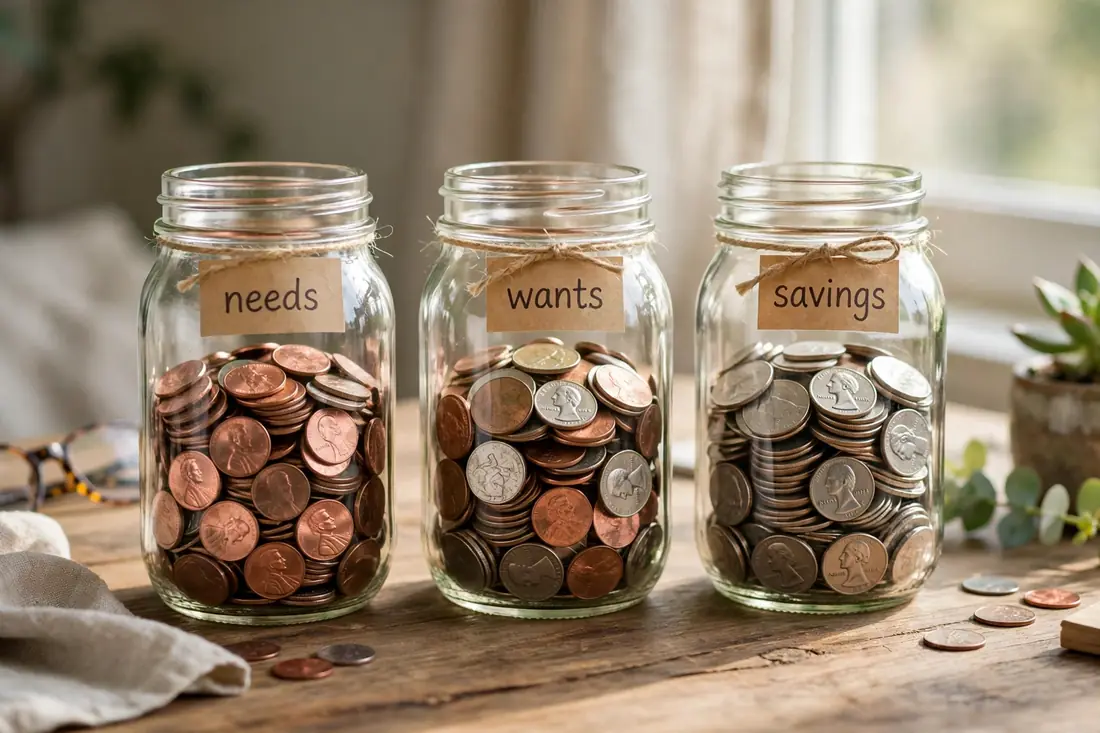
One of the simplest beginner frameworks is the 50/30/20 rule: half your take-home pay goes to needs, 30 percent to wants, and 20 percent to savings and extra debt payments. Needs are the bills you cannot skip, like rent, groceries, utilities, transport, and insurance. Wants are the fun stuff, like eating out, streaming, hobbies, and new clothes. The last 20 percent builds your safety net and chips away at debt faster than the minimum payment. Treat these numbers as training wheels, not law. If your rent eats 60 percent of your pay, your split will look different, and that is fine. The rule gives you a shape to aim for while you learn what your own numbers look like.
- 50% needs: rent, groceries, utilities, transport
- 30% wants: dining out, streaming, hobbies
- 20% savings and extra debt payments
List Your Fixed Bills First
Fixed bills are the amounts that barely change month to month, and they go at the top of the budget. Rent or mortgage, car payment, insurance, phone bill, internet, and minimum debt payments all belong here. Add them up and subtract the total from your take-home pay. What is left is the money you actually control each month, and it is usually smaller than people expect. If the fixed bills already eat nearly everything, the problem is not your willpower. It is the size of the fixed costs, and that calls for a bigger change like a cheaper plan or a roommate. Knowing the exact number stops the guessing and shows you the real room you have to work with.

Give Variable Spending a Cap
Variable spending is everything that changes: groceries, gas, eating out, clothes, and fun. These are the lines you can actually steer, so give each one a monthly cap instead of a vague hope. Groceries are usually the biggest one, and a weekly cap works better than a monthly one because it is easier to check. Put the cap in writing, check it mid-month, and if you blow past it one week, pull back the next instead of giving up. Cash in an envelope or a separate checking account makes the cap real. When the envelope is empty, the spending stops. A cap is not a punishment; it is a decision you made when you were thinking clearly.
- Groceries: set a weekly cap, not just monthly
- Eating out: one number for the whole month
- Fun money: a small amount you can spend freely

Build a Small Emergency Cushion First
Before you chase big savings goals, build a small cushion of $500 to $1,000 in a separate savings account. This is the money that keeps a flat tire or a broken phone from turning into credit card debt. It does not need to be impressive. It needs to exist. Put a small automatic transfer in place, even $25 a paycheck, and let it grow quietly in the background. Once the cushion is full, that same transfer can roll into a bigger emergency fund, which most experts put at three to six months of expenses. The cushion is the single most useful first goal in any beginner budget, because life does not wait for you to feel ready.

Automate the Boring Parts
Willpower runs out by the third week of the month, so let your bank do the boring work. Set up automatic transfers that move money on payday, before you have a chance to spend it. Your savings transfer, your extra debt payment, and your bill payments can all run on autopilot. The trick is timing: schedule everything for the day your paycheck lands, so the money is gone before it feels like yours. You will spend the month on what is left, which is exactly how a budget is supposed to work. Automation turns good intentions into a system, and systems beat willpower every single time.
- Payday transfer to savings, same day as pay
- Autopay for rent, utilities, and minimums
- Extra debt payment on autopilot

Pick One Spending Leak to Fix
Fixing everything at once is how budgets die. Pick one leak, the one that annoys you most, and fix only that for a month. For a lot of people it is food delivery, which can run three or four times the cost of cooking the same meal. For others it is subscriptions they forgot about, or the daily coffee run. Cancel the forgotten ones, cook three extra nights a week, or set a hard weekly limit on the leak you picked. One fix saves real money and, more importantly, proves to you that the budget works. Next month, pick the next leak. Small wins stack up faster than one giant overhaul that falls apart by week two.

Review Your Budget Every Payday
A budget is a living plan, not a poster on the fridge. Spend ten minutes every payday checking what you spent, what is left, and whether any cap needs moving. Did groceries run high because you hosted family? Shift money from the fun line to cover it, and move on. Did you come in under on transport? Move the extra to savings. This quick check-in is where budgeting actually happens. The first draft of a budget is a guess, and the monthly reviews are what turn it into a plan that fits your real life. Skip the review and the budget slowly drifts until it means nothing.

When Your Budget Breaks, Adjust It, Do Not Quit
Almost every beginner budget breaks in the first two months, and that is normal. A car repair, a birthday, a medical bill: real life does not follow a spreadsheet. When it happens, the worst move is to throw the whole budget away and decide budgeting is not for you. Instead, look at what broke it, move money between lines to cover the gap, and keep going. A budget that bends is a budget that lasts. The people who stick with budgeting are not the ones who never overspend; they are the ones who adjust and continue. Give yourself three months before you judge the system. By then, the numbers will look like your life, not someone else's plan.

✅ Guide4U Checklist
- Find your true take-home pay first
- Track every dollar for one month
- Try the 50/30/20 split as a start
- List fixed bills before anything else
- Cap variable spending weekly
- Save a $500 to $1,000 cushion first
- Automate transfers on payday
Key Takeaways
- Budget on take-home pay, never on salary
- Track first, set limits second
- Automate on payday and review every payday
Frequently Asked Questions
How much should a beginner save each month?
Start with whatever you can hold steady, even $25 a paycheck, because $25 saved beats $0 every time. A common first target is 10 to 20 percent of take-home pay, but a small amount you actually keep is better than a big target you abandon after two weeks. Build the $500 to $1,000 cushion first, then raise the amount a little each time you get a raise.
What if my income changes every month?
Budget with your lowest recent month as the base, and treat anything above it as extra. In good months, send the extra straight to savings or debt before you spend it. A variable income needs a buffer more than a fixed one does, so the emergency cushion matters even more when the paychecks move around.
Do I need a budgeting app?
No. A notebook, a spreadsheet, or a notes app works fine, because the best tool is the one you will actually open every payday. Apps help if you want automatic tracking, but a simple written list beats a fancy app you never check. Pick the simplest tool and stick with it for three months before you try anything new.
How long until budgeting feels normal?
Most people need two to three months before the numbers feel like theirs. The first month is mostly learning where the money goes, and the second month is fixing the biggest leak. By the third month, the caps feel natural and the payday review takes ten minutes. Stick with it through the awkward start.
What did you think of this article? Share your opinion in the comments below — we would love to hear from you.